
Plenary Speakers
Plenary Talk 1:
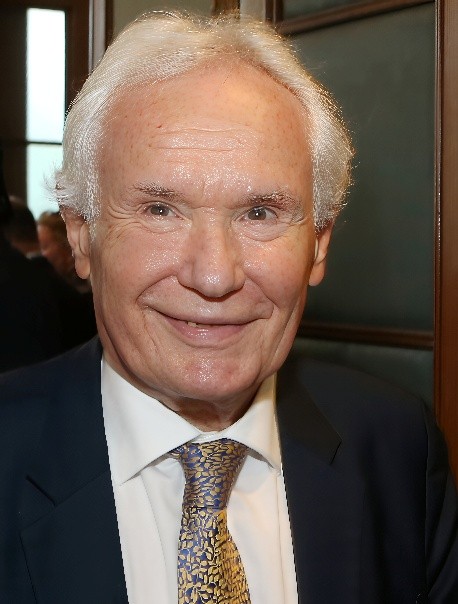
Professor Sir David Payne
University of Southampton, United Kingdom
Title: Re-Imagining the Global Internet: “Nothing” is better than silica fibre
Abstract:
Conventional optical fibres have guided light through solid glass cores for more than half a century. Since their invention in the 1960s, they have become the foundation of global communications, with close to half a billion kilometres installed every year. Today, we stand at the threshold of the next major transformation: the arrival of ultra‑low‑loss hollow‑core fibre (HCF).
By replacing glass with air as the transmission medium, and using a meticulously engineered geometrical structure in the cladding to confine the light, hollow‑core fibres retain all the strengths of traditional fibres while removing the fundamental limitations imposed by solid glass. The performance gains are profound: latency reduced by around 30%, nonlinearity suppressed by more than a factor of a thousand, and the prospect of losses as low as 0.03 dB/km — low enough to support repeaterless transoceanic links. When manufactured at scale and integrated into commercial cable systems, these fibres promise a step‑change in global data capacity and a dramatic reduction in cost‑per‑bit. In short, they offer the opportunity to reshape the communications landscape once again.
A fibre with an “air core” also brings exceptional environmental stability, opening new possibilities in precision sensing, inertial navigation, timing distribution, and high‑frequency financial trading. And because the cladding behaves as a more than just a lower index material, we gain unprecedented geometric freedom: the ability to design dispersion profiles, loss windows, and operating regimes that simply do not exist in nature.
This talk will highlight the remarkable opportunities unlocked by these radical fibre architectures — from next‑generation global networks to advanced sensing platforms — and outline why hollow‑core technology represents one of the most significant advances in fibre optics since the original invention of the solid‑core fibre.
Biography:
Prof D. N. Payne is an internationally distinguished research pioneer in photonics, having been in the field for over 50 years. Optical fibre technology is one of the greatest scientific successes of the last three decades and Payne’s contributions are acknowledged as seminal in many areas. Optical fibres underpin the internet, provide new laser capability and environmental sensing, and drive growth to the benefit of all nations.
Payne’s work spans many diverse areas of photonics, from telecommunications and optical sensors to nanophotonics and optical materials. As others have noted, with his colleagues he has made many of the key technical achievements in almost every area of optical fibre technologies and his work has had a direct impact on worldwide telecommunications, as well as nearly all fields of optical R&D. As a result, he is the most highly honoured UK scientist in photonics.
David’s pioneering work in fibre fabrication in the 70’s resulted in almost all the special fibres in use today. He led the team that in 1985 first announced the silica fibre laser and the Erbium-Doped Optical Amplifier (EDFA), the device that fuelled an explosive growth in the internet through its ability to transmit and amplify vast amounts of data. The EDFA is widely regarded as being one of the foremost and most significant developments in modern telecommunications.
David is widely regarded as a charismatic and influential speaker, with extensive international experience. He is known throughout the world and is much in demand as a Plenary Speaker for his insight in a diverse range of scientific topics.
He has published over 650 Conference and Journal papers and been awarded the top American, European and Japanese prizes in photonics, a rare achievement.
As well as the UK Rank Prize for Optics and the prestigious US Tyndall Award, he is a Franklin Laureate (USA), an Eduard Rhein Laureate (Europe) and a Millennium Prize Laureate. He is also an original member of the Highly Cited Researchers (USA) where he is honoured as one of the most referenced, influential researchers in the field and a Thomson REUTERS Citation Laureate.
In 2013, he was Knighted for services to photonics in the Queen’s New Year’s Honours and in 2018 with his colleagues won the Queen's Anniversary Prize that celebrates excellence, innovation and public benefit in work carried out by UK universities.
Plenary Talk 2:

Dr. Dennis Cai
Alibaba Cloud, United States
Title: Network Architecture Evolution for the Agentic AI Era
Abstract:
As large models shift from training to inference-centric architectures, AI infrastructure undergoes a fundamental transformation. The rise of Agentic AI demands efficient, predictable token production at scale—imposing unprecedented requirements on optical interconnects, the backbone of AI computing networks.This keynote traces the evolution of Alibaba Cloud's AI network architecture across three dimensions: Scale-out (HPN and TPN), Scale-up (UPN), and Scale-across (eCore). We examine the optical interconnect technology stack enabling these architectures: 800G/1.6T Pluggable Optics, 3.2T/6.4T NPO, and the path toward future terabit solutions. The discussion spans switch silicon photonic integration, high-radix architectures, and advanced packaging technologies that together define next-generation AI-optimized interconnects. Join us to explore how emerging AI workloads are reshaping optical network design—and what this means for the future of AI infrastructure at scale.
Biography:
Dennis Cai is the Vice President of Product & Engineering and the Head of Network R&D at Alibaba Cloud Intelligence Group. He is a prominent figure in the field of cloud infrastructure, specifically known for his leadership in developing high-performance networking solutions that power some of the world’s largest AI and cloud ecosystems.
Professional Profile
As a key architect of Alibaba Cloud’s physical and software-defined networks, Dennis Cai oversees the evolution of network infrastructure across several domains:
· Data Center Networking: Designing predictable, low-latency architectures (such as the HPN - High Performance Network) specifically optimized for Large Language Model (LLM) training.
· Edge & Backbone: Driving the strategy for metro, backbone, and edge networks to support global cloud distribution.
· Infrastructure Innovation: Leading research into RDMA (Remote Direct Memory Access), advanced congestion control, and SDN 3.0, which utilizes programmable hardware to create "predictable" network services.
Plenary Talk 3:

Dr. Glenn Parsons
Ericsson, Canada
Title: The Optical Foundation of the AI and 6G Era: Connecting Compute, Communications, and Intelligence
Abstract:
The convergence of artificial intelligence, cloud computing, and next-generation communications is reshaping how networks are designed, built, and operated. Emerging applications are driving unprecedented demands for bandwidth, latency, synchronization, resilience, and energy efficiency, while increasingly distributing intelligence across data centers, networks, and edge environments.
Optical networking is becoming a foundational infrastructure layer for this transformation, enabling the efficient movement of data between compute resources, users, devices, and services at global scale. From data center interconnects to metro, transport, access, and mobile networks, optical technologies provide the performance and scalability needed to support the growing integration of computing and communications.
This keynote explores the evolving role of optical networks in an era where compute, communications, and intelligence are becoming deeply interconnected. It examines emerging architectural trends, operational challenges, and opportunities for collaboration across industry, academia, and standards communities to build the open, interoperable, and sustainable infrastructure that will underpin the next decade of innovation.
Biography:
Glenn Parsons is an internationally known expert in networking, including mobile transport and Ethernet. He is a standards advisor with Ericsson Canada, where he coordinates standards strategy and policy for Ericsson, including network architecture for 5G radio transport networks. Previously, he has held positions in development, product management and standards architecture in the ICT industry. Over the past number of years, he has held several management and editor positions in various standards activities, including IETF, IEEE, and ITU-T. He has been an active participant in the IEEE-SA Board of Governors, Standards Board, and its Committees since 2004. He is currently involved with mobile transport standardization in IEEE and ITU-T and is the chair of IEEE 802.1. In addition to being the founding Editor-in-Chief for IEEE Communications Standards Magazine, he was previously a Senior Technical Editor for IEEE Communications Magazine. He graduated in 1992 with a B.Eng. degree in electrical engineering from Memorial University of Newfoundland.

WESTLAKE UNIVERSITY

ZHEJIANG UNIVERSITY

POC

LUSTER

IEEE Photonics Soceity

OPTICA

SPIE

THE CHINESE OPTICAL SOCIETY

CHINA INSTITUTE OF COMMUNICATIONS

CHINA INSTITUTE OF ELECTRONICS

Learning Conference