
Plenary Talks
| Alan Willner University of Southern California, USA Title: High-Capacity Optical Communications using Multiplexing of Multiple Orthogonal Beams |
Biography: Prof. Alan Willner is currently the Steven and Kathryn Sample Chaired Professor of the Univ. of Southern California. He is a member of the U.S. National Academy of Engineering, International Fellow of the U.K. Royal Academy of Engineering, Presidential Faculty Fellows Award from the White House. He is a Fellow of the AAAS, IEEE, IET, OSA, SPIE and National Academy of Inventors. Prof. Willner has received many awards, including IEEE Eric E. Sumner Award, Paul Forman Engineering Excellence Award (OSA), IEEE Photonics Society Engineering Achievement Award, SPIE President's Award, OSA Robert Hopkins Leadership Award, etc. He is a Member of the U.S. Army Science Board, was a Member of the Defense Sciences Research Council and co-Chair of the U.S. National Academies Committee on the Optics and Photonics Study. He was the President of the Optical Society (OSA) and President of the IEEE Photonics Society (formerly LEOS). Prof. Willner was the Editor-in-Chief of Journal of Lightwave Technology (JLT) Optics Letter and IEEE Journal of Selected Topics in Quantum Electronics, as well as the associate Editor or guest editor of various journals. Prof. Willner has >1300 publications, including one book, 9 edited books, >35 U.S. patents, >39 keynotes/plenaries, >23 book chapters, >375 refereed journal papers, and>225 invited papers/presentations. His research is in optical technologies, including: communications, signal processing networks, and subsystems. |

| Qihuang Gong Peking University, China Title: Ultra-high-Q microcavity optics and photonics |
Biography: Professor Qihuang Gong is the Academician of Chinese Academy of Science and member of the World Academy of Sciences. He is the Founding Director of the Institute of Modern Optics, Peking University. He serves as the Vice President of Peking University, the President of the Chinese Optical Society, and the Vice President of the Chinese Physical Society. He is the Standing Committee member of China Association for Science and Technology, the vice president for lCO (International Commission for Optics) and vice chair for lUPAP C17. His current research interests include ultrafast optics and spectroscopy, nonlinear optics, and mesoscopic optical devices for applications in optical information processing and communication. He has authored more than 600 articles in Science, Nature Photonics, Nature Physics, PNAS, PRL Physics Report etc. These papers have received approximately12000 citations, with an H-index of 46. Prof. Gong has received numerous awards, including The State Natural Science Award (2nd-Class), the Beijing municipal government Science and Technology Award (1st-Class), the Science and Technology Award (1st-Class) of Ministry of Education, the Rao Yutai Physics Prize given by the Chinese Physical Society, the Wang Daheng Prize given by the Chinese Optics Society and HLHL Science and Technology Award. |

| Chennupati Jagadish Australian National University, Australia Title: Semiconductor Nanowires for Optoelectronics Applications |
Biography: Prof. Jagadish is a Distinguished Professor of the Australian National University. He is currently serving as President of EEE Photonics Society and President of Australian Materials Research Society. His research interests include compound semiconductor optoelectronics, nano-technology, photovoltaics and neuroscience and neurotechnology. He is a Fellow of the Australian Academy of Science and the Australian Academy of Technological Sciences and Engineering, a Fellow of IEEE, APS, OSA, SPIE, AAAS, TWAS, etc., a Fellow of the US National Academy of Inventors, an Honorary Fellow of the Indian Academy of Sciences and Indian National Academy of Engineering. He is currently serving as an Editor-in-Chief of Progress in Quantum Electronic, an Editor of the Journal Semiconductor Technology and Science and an Associate Editor of Applied Physics Reviews and Journal of Physics D: Applied Physics. He has been awarded Australian Federation Fellowship2004 2009) and Australian Laureate Fellowship (2009201 4) by the Australian Research Council. He has received many awards, including The Quantum Device Award (ISCS2010), IEEE Pioneer in Nanotechnology Award (2015), IEEE Photonics Society Engineering Achievement Award (2015) Distinquished Fellow of the Chinese Academy of Sciences President's International Fellowship lnitiative (2016), Welker Award from ISCS (2017), IUMRS Somiya Award (2017) and AVS Nanotechnology Recognition Award (2018). |

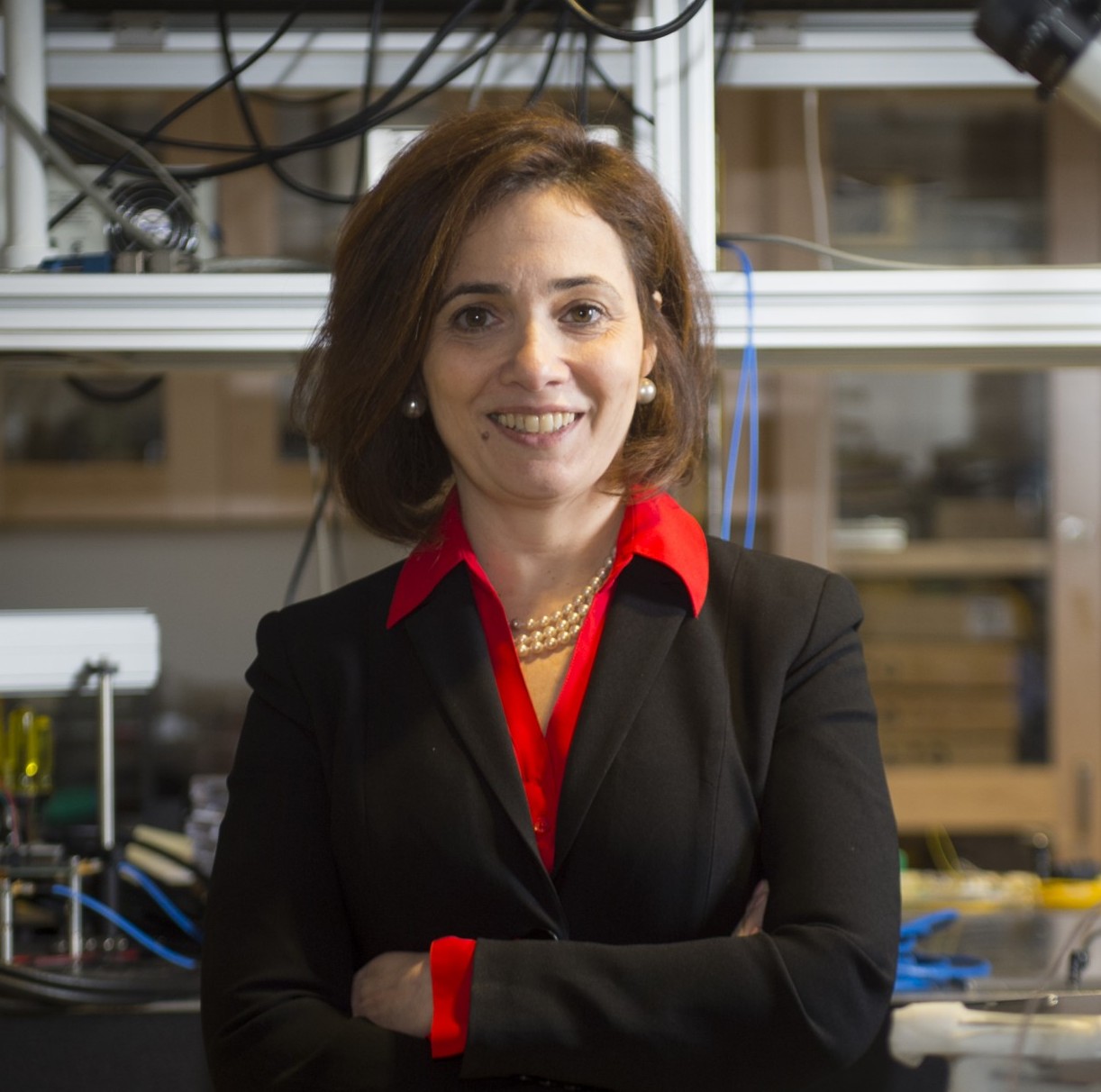
| Michal Lipson Columbia University, USA Title: Next Generation Silicon Photonics |
Biography: Prof. Michal Lipson is the Eugene Higgins Professor at Columbia University. Her research focus is on Nanophotonicsand includes the investigation of novelphenomena, as well as the development of novel devices and applications. Prof. Lipson pioneered critical building blocks in the field of Silicon Photonics, which today is recognized as one of the most promising directions for solving the major bottlenecksin microelectronics. She is the inventor of over 30 issued patents and has co-authored more than 200 scientific publications. In recognition of her work in silicon photonics she was elected as a member of the National Academy of Sciences. She was also awarded the NAS Comstock Prize in Physicsthe MacArthur Fellowship, the Blavatnik Award, the OpticaSociety's R. W Wood Prize the lEEE Photonics Award. She is also a Fellow of IEEE and OSA. Since 2014 every year she has been named by Thomson Reuters as a top 1% highly cited researcher in the field of Physics. |
Plenary Presentations on Charles Kao Symposium on Optical Fiber Communications
Chairs:
Alan Willner, University of Southern California, USA
Xiang Liu, Futurewei Technologies, USA
ACP 2019 will feature 4 plenary presentations on Charles Kao Symposium on Optical Fiber Communications. For more information about the individual presenters, talk titles and biographies appear below.
From 20 dB/km to 0.14 dB/km: Optical Fiber Evolution Over the Past Five Decades

MingJun Li
Comning inc, USA
Dr Ming Jun Li joined Corning in 1991 and is currently a Corporate Fellow. He has contributed to many fiber products including bend insensitive fiber for FI THarge effective area fiber, ultra-low PMD fiber and ultra low loss fiber for high datarate transmission, low SBS fiber for analog transmission, high bandwidth MMF for data centers, various specialty fibers for connectors, fiber lasers, sensors and endoscopes, multicore fibers and few mode fibers for space division multiplexing, and new glass waveguide devices for optical interconnect and sensing applications.Dr Li received the 1988 French National Prize on Guided-wave Optics, and Corning's 2005 Stookey Award. He was a member of teams who won 1999 R8D 100 Award for LEAF® fber, 2008 R&D 100 Award for ClearCurveR fiber, 2008 ACS Northeast Regional Industrial Innovation Award, and 2017 ACS Heroes of Chemistry. He is a member of the US National Academy of Engineering, a Fellow of OSA and EEE. He has served as Associate Editor, Coordinating Com-mittee Member, and Deputy Editor for Journal of Lightwave technology. He has also served as a guest editor for several special joural issues and as committee chair or member for many international conferences. He holds 202 U.S. patents and has published 8 book chapters and authored over 290 technical papers.
Optical Fibre Amplifiers and Their lmpact: Past Present and Possible Future

David Richardson
University of Southampton, UK
David Richardson has been Deputy Director of the Optoelectronics Research Centre (ORC) at the University of South-ampton with responsibility for optical fibre and laser related research since 2000. He has published more than 1300 research papers and produced more than 30 patents during his time at Southampton.
Professor Richardson is a Fellow of the lEEE, OSA and IET and was elected a Fellow of the Royal Academy of Engineering in 2009. He received a Royal Society Wolfson Research Merit Award in 2013 for his optical communications research and was a recipient of the H2020 “Breaking the OpticalTransmission Barriers" Horizon Prize following his involvement in the PHOTONMAP consortium. He currently leads the EPSRC-funded Airguide Photonics programme.
He was one of the co-founders of SPl Lasers Ltd, an ORC spin-off venture acquired by the Trumpf Group in 2008, and more recently of Lumenisity Ltd which he co founded in 2017.
Communication System Scaling Using Massive Spatial Parallelism: From Chip-to-Chip Interconnects to Submarine Optical Cables

Peter Winzer
Bell Labs, USA
Peter J. Winzer currently heads the Optical Transmission Systems and Networks Research Department at Bell Labs in Holmdel, NJ. At Bell Labs since 2000 he has focused on various aspects of high-bandwidth fiber optic communication systems. He contributed to several high-speed and high-capacity optical transmission records with interface rates from 1 0 Gb/s to 1 Tb/s, including the first 100G and the first 400G electronically multiplexed optical transmission systems and the first field trial of live 100G video traffic over an existing carrier network. Since 2008 he has been investigating and intemationally promoting spatial multiplexing as a promising option to scale optical transport systems beyond the capacity limits of single-mode fiber. Dr. Winzer is a Clarivate Highly Cited Researcher, the only one from industry in the Engineering category in 2015, a BelLabs Fellow, a Fellow of the lEEE and the OSA, and an elected member of the US National Academy of Engineering. He received Thomas Ala Edison Patent Award in 2017 and is the recipient of the 2018 John Tyndall Award. Dr Winzer is currently serving as Editorin-Chief of the IEEE/OSA Joumaof Lightwave Technology. He was Program Chair of the 2009 European Conference on Optical Communications (ECOC) and Program Chair and General Chair of the 2015 and 2017 Optical Fiber Communication Conference (OFC).
Silicon Photonics and Coherent Communications: A Happy and Fruitful Marriage

Christopher Doerr
Acacia Communications, USA
Christopher R. Doerr earned a B.S. in aeronautical engineering and a BS.M.S., and Ph.D. in electrical engineering from the Massachusetts Institute of Technology. He was a pilot in the U.S. AirForce. Since joining Bell Labs in 1995, Doerr's research has focused on integrated devices for optical communication.
He is a Fellow of IEEE and OSA. He received the OSA Engineering Excellence Award in 2002. He was Editor-in-Chief of EEE Photonics Technology Letters from 2006-2008. He was an Associate Editor for the Joural of Lightwave Technology from 2008-2011. He was awarded the lEEE William Streifer Scientific Achievement Award in 2009 and Microoptics Conterence Award in 2013. He became a Bell Labs fellow in 2011. He joined Acacia Communications in 2011 as Associate Vice President of Integrated Photonics.

电子科技大学

西安交通大学

CLP

FCMT

Huawei

国家信息光电子创新中心

中国信科

CCELINK

Light

OSA

IEEE Photonics Soceity

SPIE